




Scour Bos
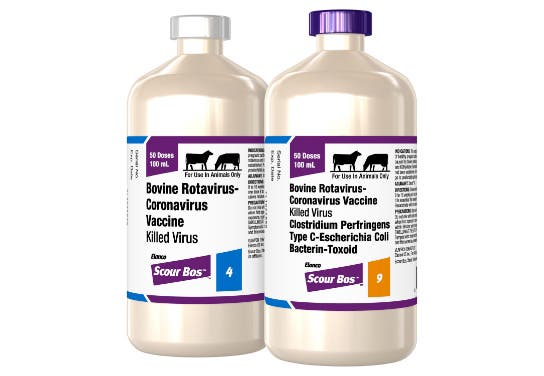
Scour Bos
Few diseases devastate a herd like scours. Preparing passive immunity protection for day one is critical. Scour Bos® provides comprehensive protection against up to nine antigens for broad-spectrum coverage against the leading causes of scours, while the most flexible administration schedule on the market gives you up to four months pre-calving to integrate Scour Bos into your herd health protocol.
Dosage

2 mL
Key Benefits:
- Comprehensive protection against nine causes of scours
- More colostral antibody titers for Bovine Rotavirus and Bovine Coronavirus1
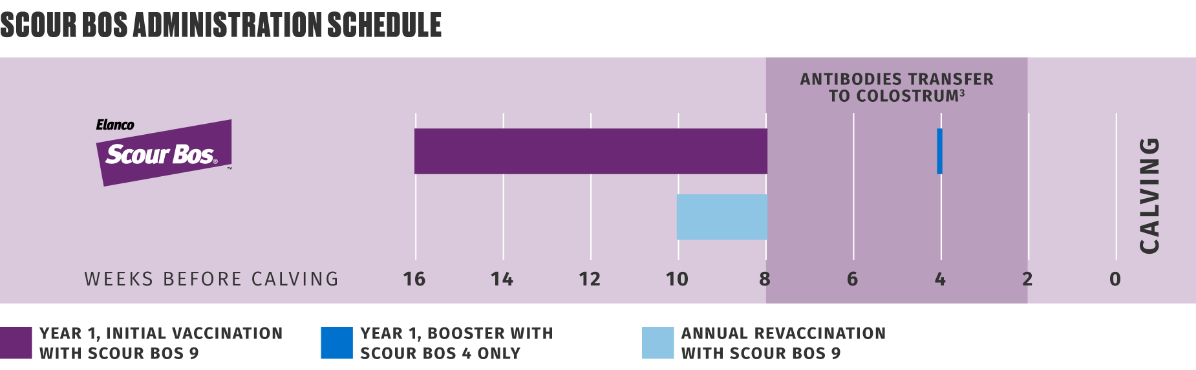
- Up to 4-month or 16-week initial vaccination window
Why Choose Scour Bos?
Over 97% of veterinarians who used Scour Bos said it met or exceeded expectations, despite severe weather.2 Animals vaccinated with Scour Bos have significantly higher colostral antibody titers to Bovine Coronavirus and numerically higher colostral antibody titers to Bovine Rotavirus than the competition.1 Plus, Scour Bos provides a vaccination window up to 16 weeks, longest on the market.

Up to 9 antigens, providing more coverage than any other scours vaccine.

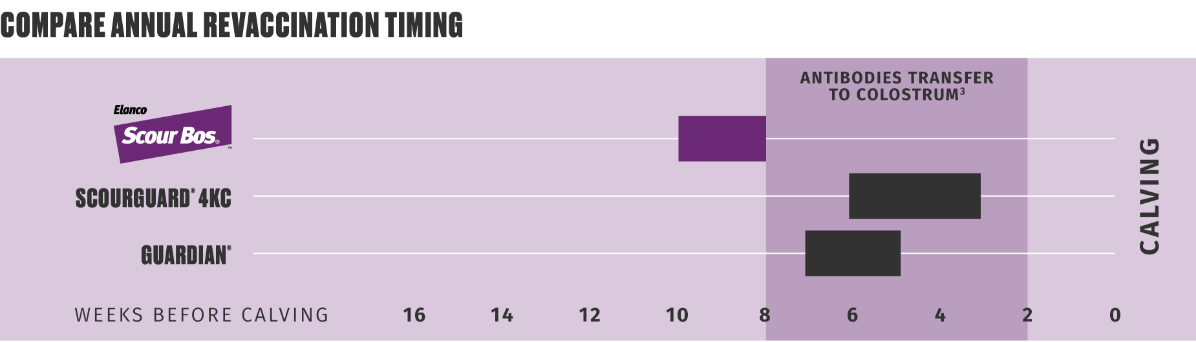
The widest window for administration on the market.

Met or exceeded expectations for 97% of vets.2

Scour Bos Gives You More
Scour Bos provides comprehensive protection against up to nine antigens for broad-spectrum coverage against the leading causes of scours with the most flexible administration schedule on the market.
| Scour Bos 9 | ScourGuard® 4KC | Guardian® | |
| Comprehensive | |||
| No. of antigens available | 9 | 5 | 7 |
| No. of E. coli isolates | 4 | 1 | 1 |
| No. of Bovine Rotavirus isolates | 3 | 2 | 2 |
| Protection against Bovine Coronavirus | ✓ | ✓ | ✓ |
| Protection against C. perfringens Type C | ✓ | ✓ | ✓ |
| Flexible | |||
| Initial vaccination flexibility (weeks prior to calving) | 8 to 16 weeks | Up to 9 weeks | Up to 12 weeks |
| Annual vaccination flexibility (weeks prior to calving) | 8 to 10 weeks | Up to 6 weeks | Up to 7 weeks |
Flexible Administration
Scour Bos can be given at preg check or dry off. The Xtend® III adjuvant provides long lasting immune system stimulation that helps to release antigens over time.
To learn more about how Scour Bos gives you more, contact your herd health veterinarian or Elanco representative. To find a representative, please call 1-800-364-2014.

Important Information
Learn about Scour Bos indications, directions and safety precautions.
Indications
Directions
Precautions
Indications
Scour Bos 4
This product has been shown to be effective for the vaccination of healthy pregnant cattle to provide passive immunity in calves against disease by Bovine Rotavirus and Bovine Coronavirus. The duration of immunity for this product has not been established. For more information regarding efficacy and safety data, go to productdata.aphis.usda.gov.
Scour Bos 9
This product has been shown to be effective for the vaccination of healthy pregnant cattle to provide passive immunity in calves against disease by Bovine Rotavirus, Bovine Coronavirus, Clostridium perfringens Type C and K99 piliated Escherichia coli. The duration of immunity for these antigens has not been established. For more information regarding efficacy and safety data, go to productdata.aphis.usda.gov.
Downloadable Resources
Looking for more information? Access these resources or contact your Elanco representative. To find a representative, please call 1‑800‑364‑2014.


For all vaccine products: The label contains complete use information, including cautions and warnings. Always read, understand and follow the label and use directions.